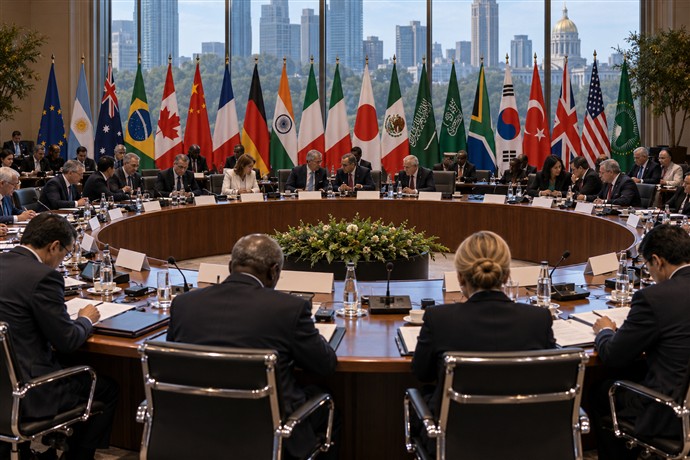
G20 Foreign Ministers Finish Atlanta Meeting Without Joint Agreement

Adrian Solmere
Last updated: November 2, 2026
Foreign ministers from the
Group of 20 economies have concluded two days of talks in Atlanta without reaching consensus on several major
international security issues.
The meeting ended without a joint communiqué, the document traditionally used to record positions accepted by all participating governments. Instead, the United States released a chair’s statement summarising the discussions and the priorities raised during the meeting.
Russia’s war with Ukraine was among the most significant areas of disagreement. Ministers also discussed
food and energy security, freedom of navigation, economic coercion and the protection of
international supply chains.
US Secretary of State Marco Rubio acknowledged the depth of the divisions.
“I wouldn't pretend to you today that we are close to finding universally accepted solutions to these problems,” Rubio told reporters.
The chair’s statement identified areas requiring further international attention but did not announce a major collective agreement. It warned that food supply chains are increasingly being used to place political pressure on other countries.
The diplomatic impasse does not mean the G20 has ceased functioning. Members can still cooperate on individual policies, and the meeting provided an opportunity for direct discussions between governments that disagree on major issues.
However, the absence of a consensus statement demonstrates how geopolitical conflicts are making cooperation more difficult. The G20 includes countries with sharply different positions on Russia, Ukraine, China, trade and Western foreign policy.
The outcome also places additional pressure on the
G20 leaders’ summit expected to be hosted by President Trump in Florida. Officials will need to determine whether common ground can be found before national leaders gather.
Although the G20 began primarily as an economic forum, wars,
trade restrictions and energy disruptions now have a direct effect on inflation, investment and food security. That has made international security increasingly difficult to separate from the group’s economic responsibilities.